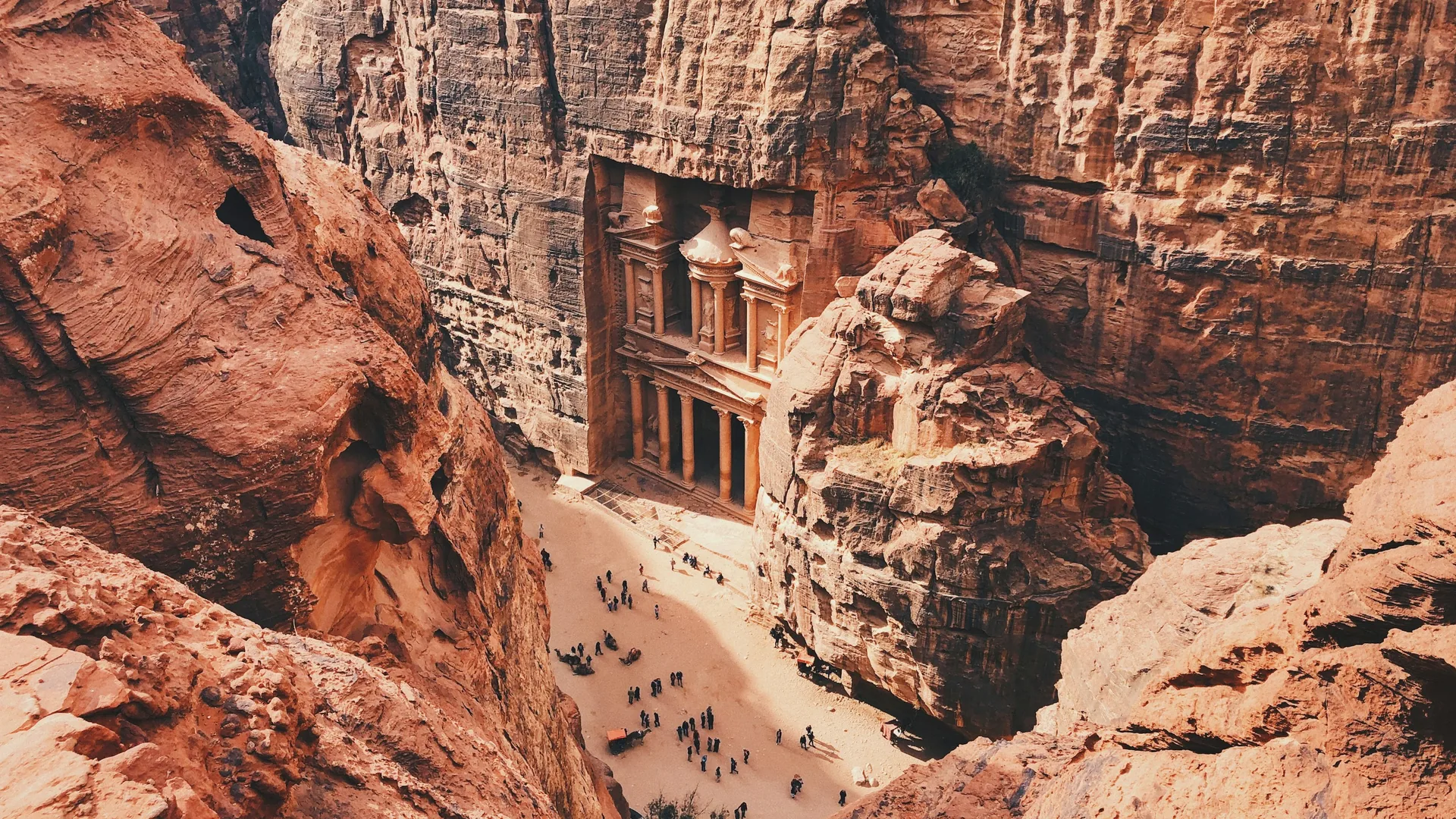
You come down through a slot in the rock barely wide enough for a chariot, the walls closing to a slice of sky, and then the Siq opens and the Treasury is just there — forty metres of columns and urns cut straight into a rose-pink cliff by people who left almost no other record of themselves. Petra is not a monument you look at; it is a city you walk into, and the getting-there — the drive from Amman, the ticket, the early start that beats the heat and the crowds — is most of what stands between you and that first moment.
The Siq is the narrow natural fissure that serves as the only entrance to the main Petra basin — a 1.2-kilometre cleft in the sandstone created by tectonic movement and subsequently shaped by water erosion. At its narrowest points it is barely three metres wide; the cliffs rise more than 80 metres overhead, occasionally closing overhead and reopening to admit narrow slants of sunlight. The walk takes 20–25 minutes at a steady pace, longer if you stop to examine the carved water channels running along both walls. The right-hand channel was a ceramic-piped clean-water system carrying water from the Ain Musa spring at Wadi Musa into the city; the left-hand open channel handled flash-flood runoff. Small terracotta pipe segments remain in situ along several sections. This twin-channel hydraulic engineering is one of the reasons UNESCO inscribed Petra under criterion iii.
The Siq ends in a slit-thin gap that frames the Treasury (Al-Khazneh) as the visitor approaches — a 24-metre wide, 39-metre tall Hellenistic facade carved directly into the rose-pink sandstone cliff. The reveal is the photograph everyone has seen, and the structured anticipation of the approach makes it work on every visitor regardless of how many images they have already encountered. Built in the early 1st century AD, almost certainly as the mausoleum of Nabataean King Aretas IV (9 BC – 40 AD), it earned its modern name from a Bedouin legend that the urn at the top concealed a pharaoh's gold; bullet marks visible on the urn are from 19th- and 20th-century treasure-hunters firing at it from below in attempts to release the supposed treasure. The interior chamber is no longer accessible to visitors, and has not been since 2003.